November 19, 2026
Putin Promised Modi to Free Indians From His Army, but Recruitment Goes On, Indian POW Says
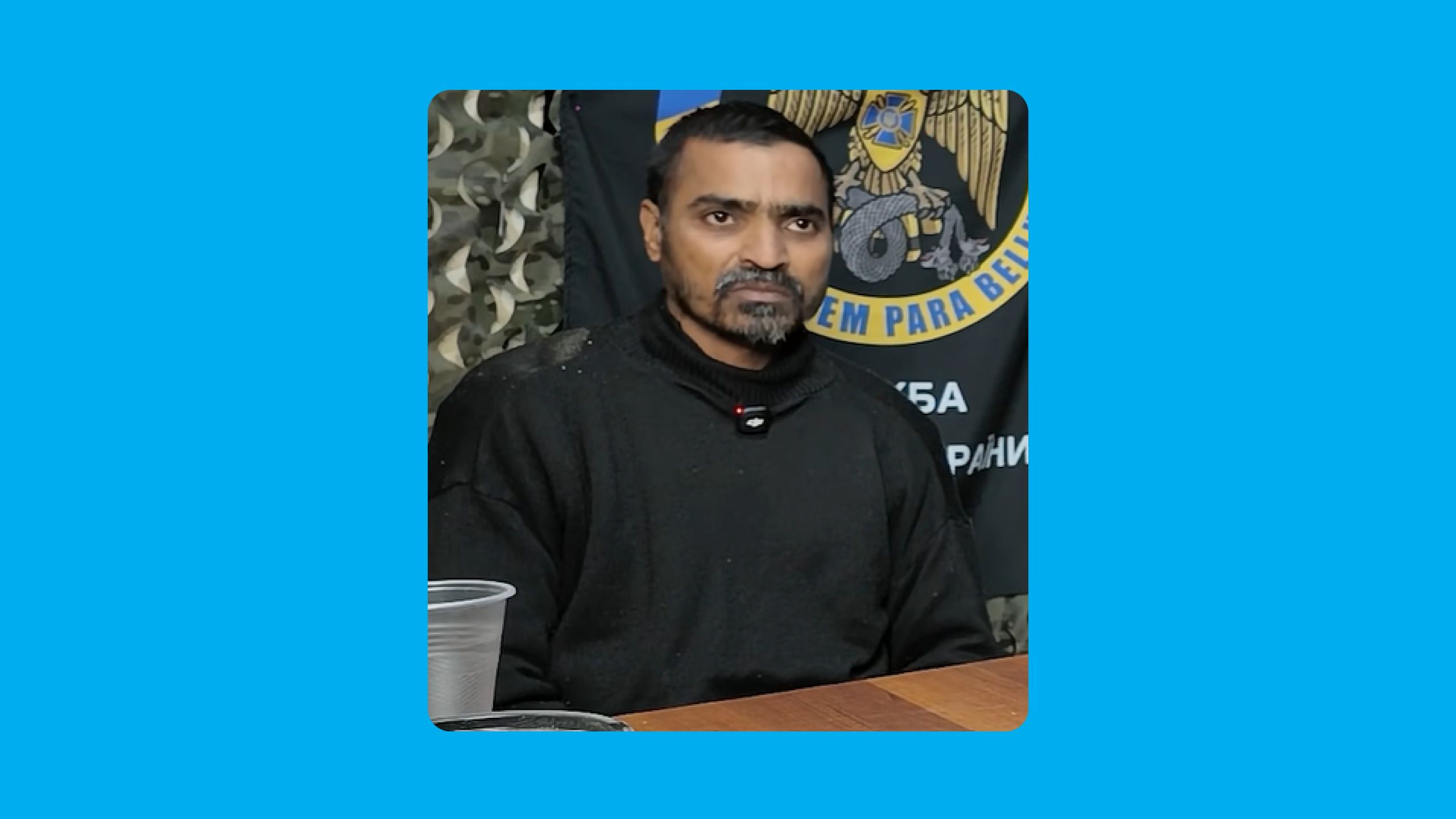
More than two years after Vladimir Putin promised Narendra Modi to help free Indians misled into Russia's army, Gurpreet Singh Randhawa, an Indian man from the Jalandhar district of Punjab, said a Facebook advertisement for a driving job at a Russian factory ended with him in Russia's army and on the front line in Ukraine. He told his story in an interview as a prisoner of war, and said he later escaped from his unit and reached Ukrainian forces to surrender. The interview is available on Youtube:
A Promise Made to Modi
During Modi's July 2024 visit to Russia, Putin agreed to help release Indians who had been misled into joining the army, Reuters reported, citing an Indian official.
On 8 September 2026, Kremlin spokesman Dmitry Peskov told Indian journalists that Russia was compiling a list of Indian citizens still serving and would send them home once they were identified, according to the Tribune. As we reported at the time, it was the same pledge Moscow had made in 2024. India's foreign ministry said around two dozen Indians remained in the Russian army. The Tribune, citing Foreign Secretary Vikram Misri, gave a total of 227 Indians recruited, of whom 139 had been released and 51 had died, with the fate of the rest unclear.
The Ad and the Trip
Gurpreet said he saw the advertisement on Facebook in India. It was written in English and offered factory work in Russia with a driving job, a salary of 200,000 rupees, which is about $2,140, and a visa and flight that were "completely free." He wrote "hello" to the number in the ad on WhatsApp, was told to send his documents, and sent his passport and driving license. Four days later, he said, he received a Russian tourist visa, and then his ticket from Delhi to Moscow.
A Russian-language Telegram post about the interview added that the recruiter also sent him $500 to show at the Russian border.
He said he landed in Moscow on 17 August, was met by a Russian man, and was put in a car that night. After a night's stop, he said, he and others had a medical check and were photographed for ID documents. He was then taken to the city of Samara, where he and four other foreign men, two Indians, two Nepalis and a Bangladeshi, who he said had also come for factory work, were kept for five days.
"You Have Been Sold"
After five days, Gurpreet said, a bus took them to a road in the woods, where they waited all day with a Russian man who was holding their documents. In the evening another bus arrived, half full of Russian men who looked like soldiers in civilian clothes. After about two days of travel, he said, the Russians left and about 20 foreigners were left in a forest, including Yemenis and Sri Lankans. A closed army vehicle took them for around three hours along a dirt road to an army camp.
Gurpreet said an interpreter who spoke their language arrived about an hour later. When the men said they had come for factory work and not for the army, the interpreter told them they had already been recruited and "sold." He said the group began to cry and asked to be sent home, and the interpreter replied that they could go home only if they paid. They decided to see what would happen next.
The foreigners were housed at a hospital of the Russian Interior Ministry's medical unit in the Samara region, where they passed a medical commission and signed military contracts. Gurpreet signed the contract on 26 August 2026 and was assigned to the 589th Regiment of the 27th Division; about a hundred foreigners, including Indians and Nepalis, were at the training ground with him.
Training, Threats and the Front
Gurpreet said he was given an army uniform after four days of digging a dugout, then trained for about 35 days. He described lessons on radios, weapons, shooting and grenades, night exercises with drones overhead, and about 20 days of marches of around 20 kilometers a day with a backpack filled with soil. He said the men were left without food for three days during the marches and that anyone who fell was beaten.
He said his passport and personal phone were taken from him. When he asked for his phone to call home, he said, a Russian pointed a loaded gun at the group and said he would shoot if they asked again.
Gurpreet said there were 202 men at the camp and that five were sent to the front line every day. His turn came early. He said he was given a bag with a new phone, a rope, a knife, a power bank, a rifle and four magazines, and was driven toward the front with four other Indians.
During training two foreigners tried to run away from the training ground. One was shot dead, and the other was tied to a post opposite the entrance to a dugout and left under video surveillance, and troops were forbidden to give him food or water threatened with the same punishment. In early October the group was sent to the Pokrovsk direction, shelling on the way killed two foreigners, and Russian soldiers drove Gurpreet out of a dugout when he tried to take cover.
The Escape
Gurpreet said he moved between several positions on foot and at one point he swore on his children that he would not stay there. When a commander sent him out from a dugout toward another position, he said, he threw away his gear and ran north.
He said he got tangled in barbed wire and turned his phone on briefly. Drones and several Russian soldiers came looking for him. He hid in the grass while they searched until about 5 a.m. He then buried the phone and laid motionless for about 12 hours beside two dead bodies while drones circled above. One of the drones dropped a bomb near him. He ran again after midnight and was followed by drones all night.
Without a phone or a compass, Gurpreet said, he navigated by the sun and kept walking north, around 50 kilometers a day, eating apples and whatever else he found. When drones in the sky did not attack him after he stood in the sunlight and gestured to them, he said, he understood they were probably Ukrainian. He said he saw many dead bodies along the way. An elderly Ukrainian woman pointed him toward a city by drawing in the dirt, and a Ukrainian soldier eventually stopped a vehicle and took him in. Gurpreet said he told them he was an Indian who had run away from the Russian army.
His Message to India
Gurpreet said he never wanted to join any army, that he had come for work and has a family, and that he has two small children. Asked whether he would go to Russia again, he answered "never" and said that "Russia means death."
He appealed to the Indian government to ban visas for Russia and not to let any young man go there. He said Russia deliberately posts job ads on Facebook promising a salary of 400,000 rupees, which is about $4,200, and then "pushes everyone into the mouth of death one by one." He called Russia a "deceiver country" and said many young men from Punjab and Nepal had died in front of him, and that many more young men from Punjab were stuck there.
A Pledge Tested by the Timeline
Gurpreet's account places his recruitment before Peskov's pledge and his deployment after it. He landed in Moscow on 17 August, and signed his contract on 26 August and was sent to the front in early October, about a month after Peskov said Moscow was compiling a list to send Indians home.
A Safe Way Out
Indians and other foreign nationals lured into Russia's armed forces have an option to safely escape the battlefield with Ukraine's "I Want to Live" project. See our FAQ for recommendations for victims of Russian military recruitment and their families.